How Arcade Machine Factories Develop New Commercial Games
Discover how arcade machine factories develop new commercial games through concept design, prototyping, player testing, and manufacturing preparation.
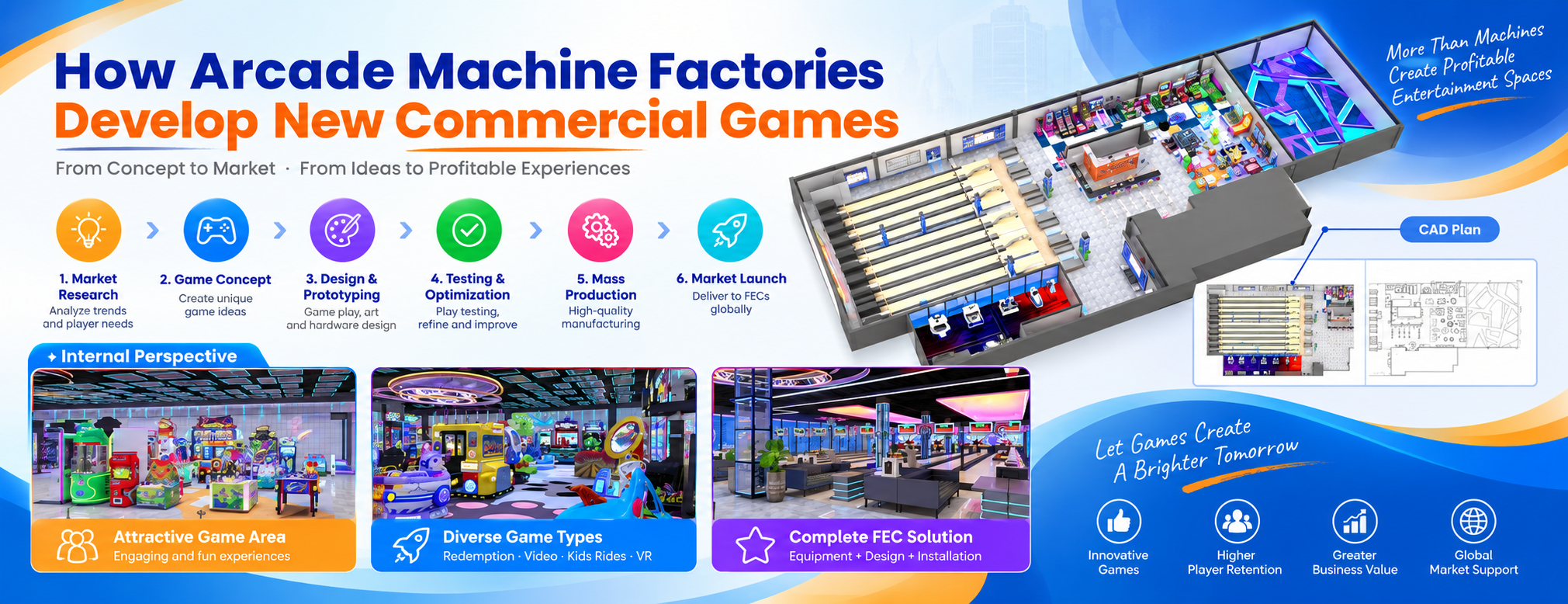
Arcade machines do not begin their commercial life on a production line. Behind a new game is a development process that connects market demand, player behavior, game design, cabinet engineering, software, hardware, testing, and manufacturing.
For arcade operators, distributors, and entertainment investors, understanding this process can reveal why some manufacturers are able to develop differentiated equipment while others mainly reproduce existing products.
A capable arcade machine factory is therefore not only a place where machines are assembled. It can also be a product development partner that turns an entertainment concept into equipment suitable for repeated commercial use.
1. Product Development Starts With Market Signals
New arcade machine development usually begins with a simple question: what experience are players looking for? Manufacturers can study operator feedback, customer preferences, emerging entertainment formats, and gaps in existing game categories before deciding whether a new concept is worth developing.
Feedback from arcade operators can be particularly valuable because operators see customer behavior directly. They can identify which experiences attract attention, which machines create repeat play, and which features may no longer feel fresh to their audiences.
Distributors can also provide useful market information because they work across different venues and regions. Their feedback may reveal differences in customer preferences, price expectations, cabinet styles, and popular game categories.
The purpose of this research is not simply to follow every new trend. A successful commercial game needs a clear reason to exist and should provide an experience that operators can understand, explain, and monetize.
This early stage helps manufacturers focus development resources on concepts that have a practical opportunity in real entertainment venues.
2. Turning an Idea Into a Playable Concept
Once a product opportunity is identified, the next step is to define the core game experience. Designers need to determine what the player does, how the game responds, and what makes the experience engaging.
A concept may start with a simple idea such as competitive racing, physical interaction, cooperative play, prize collection, or immersive simulation. The challenge is turning that idea into a repeatable experience that works within a commercial machine.
The development team must also consider how many players can participate, how long a typical session should last, and what can encourage players to try the game again.
At this stage, the concept needs to be considered from both entertainment and business perspectives. A game can be enjoyable while still being difficult to operate commercially if the hardware is too complex or the playing area is too large.
Clear concept definition gives engineering, software, and industrial design teams a common direction before detailed development begins.
3. Designing the Cabinet Around the Player Experience
Arcade cabinet design is closely connected to gameplay. The cabinet is not simply an outer shell; it determines how players interact with controls, screens, seats, sensors, and physical features.
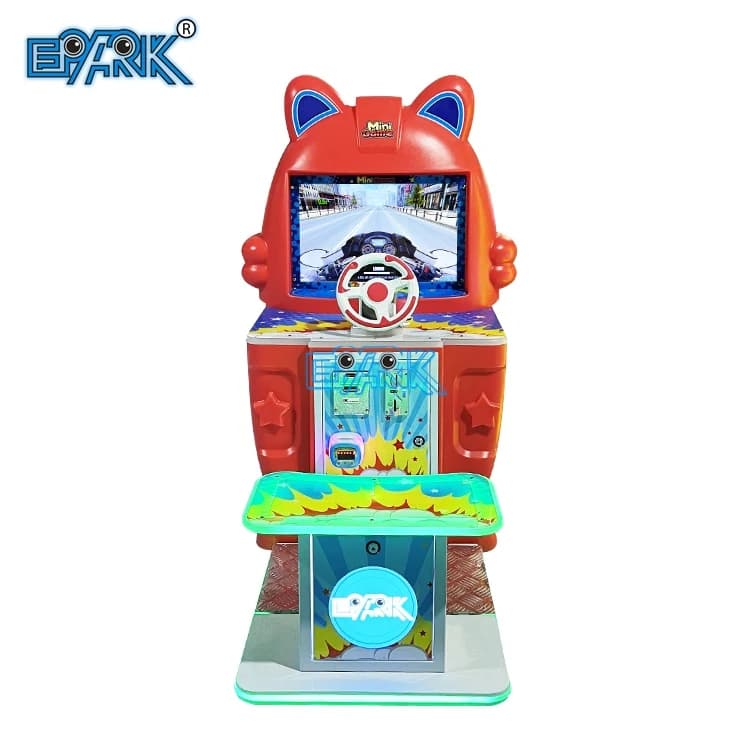
For racing equipment, the position of the steering wheel, pedals, seat, screen, and surrounding structure affects comfort and immersion. Other machines may require different control positions, viewing angles, or player distances.
Industrial designers also need to consider how a new machine will appear inside a busy entertainment venue. Strong visual recognition can help a new attraction stand out among many competing games.
At the same time, the cabinet needs to remain practical for manufacturing, transportation, installation, cleaning, and maintenance. A visually impressive design that is difficult to service may create problems later.
Good product development therefore balances appearance, player interaction, structural requirements, and practical commercial operation.
4. Hardware and Software Need to Work Together
Modern arcade machines combine physical equipment with software. A new product may require screens, game boards, sensors, controls, speakers, lighting, motors, payment systems, or other electronic components to operate as one system.
Hardware selection should be based on the intended experience rather than choosing components independently. The performance of a display, controller, sensor, or processor can affect how the game feels to the player.
Software development also needs to account for the physical machine. A game designed for a standard screen may need significant changes when it is connected to physical controls, sensors, or motion equipment.
Integration testing helps identify communication problems between hardware and software before a prototype is ready for broader testing.
This connection between engineering and game development is one reason product development experience can be valuable when choosing a commercial arcade equipment manufacturer.
5. Prototype Development Reveals Real Problems
A concept can look excellent on paper and still fail when converted into a physical machine. Prototype development gives engineers and designers an opportunity to discover problems that cannot be identified through drawings alone.
The prototype allows the team to evaluate player position, viewing angles, control response, cabinet proportions, mechanical movement, sound, lighting, and overall usability.
It can also reveal practical engineering issues. A component may work technically but be difficult to install, replace, or protect during long-term commercial use.
Early prototypes are valuable because finding a problem during development is usually easier than discovering the same problem after a large production order has been manufactured.
The goal of prototyping is not necessarily to create a perfect machine immediately. It is to create a physical version that generates useful information for the next development stage.
6. Player Testing Improves the Commercial Experience
After a prototype becomes functional, testing with real users can provide information that engineering teams cannot obtain from technical checks alone.
Players may react differently from what designers expect. They may find a control uncomfortable, misunderstand an instruction, miss an important visual signal, or prefer a different style of interaction.
Testing can therefore examine both usability and entertainment value. The team can observe whether players understand the objective, how quickly they become engaged, and whether they want to continue playing.
For commercial arcade equipment, operators can also evaluate whether the machine is easy for staff to manage. Simple startup procedures, clear settings, and accessible maintenance areas can make a difference in busy venues.
Feedback from player and operator testing can then be used to refine the product before final production specifications are established.
7. Preparing a Product for Repeat Commercial Use
A machine intended for commercial entertainment must be designed for repeated operation. Development teams need to think beyond a short demonstration and consider how the product will behave after extended daily use.
Controls, moving parts, electrical connections, screens, seats, and other components may experience frequent interaction. Their design should reflect the environment in which commercial arcade equipment is normally used.
Maintenance access is another important consideration. Technicians and venue staff need practical ways to inspect components, replace common parts, and resolve basic issues.
The product should also be evaluated for cleaning and routine operation. Entertainment venues can be busy environments, so equipment needs to remain practical for staff as well as attractive to customers.
Commercial readiness means the machine has been developed as an operating product, not simply as a demonstration model.
8. Pilot Production Helps Confirm Manufacturing Readiness
After development and testing, manufacturers may move toward a limited production stage before larger quantities are produced.
Pilot production helps confirm whether the finalized design can be manufactured consistently. It allows production teams to review assembly steps, component compatibility, wiring arrangements, and finishing requirements.
This stage is especially useful for new products because the first engineering prototype may contain solutions that need to be adjusted for efficient manufacturing.
Production teams can identify opportunities to simplify assembly, improve consistency, or make future maintenance easier without changing the intended customer experience.
The result is a stronger connection between product development and factory manufacturing, helping ensure that the final commercial version remains faithful to the original concept.
9. New Products Continue to Evolve After Launch
Product development does not necessarily end when the first machines are delivered. Real-world operation can generate new information that was not available during factory testing.
Operators may discover that customers prefer one game mode, control method, or feature more than another. They may also request changes based on the way the machine performs in their venue.
Manufacturers can use this feedback to improve future production, software updates, configurations, or related products.
For distributors, post-launch feedback can also help identify which product features are most attractive in different markets.
This creates a development cycle in which market feedback influences future products, allowing a manufacturer to build knowledge rather than treating every new machine as an isolated project.
10. Why Product Development Capability Matters to Buyers
For buyers, a manufacturer's development capability can be an important indicator of long-term value. A factory that understands product development is more likely to understand why a machine was designed in a particular way and how its components work together.
This knowledge can make technical communication easier when a buyer requests changes or needs assistance with a new project.
It can also benefit distributors that want products adapted for particular customer groups or market opportunities.
For FEC investors, product development experience may provide access to a broader range of entertainment concepts rather than limiting the project to standard equipment.
The key point is that product development and manufacturing are connected. A supplier that understands both areas can become more useful as a business grows and equipment requirements become more sophisticated.
How EPARK Supports Arcade Equipment Development
EPARK is a commercial amusement equipment manufacturer based in Guangzhou, China, with more than 14 years of industry experience. The company serves FEC operators, arcade owners, distributors, importers, wholesalers, and entertainment investors in international markets.
EPARK's product range covers commercial arcade machines, racing games, shooting games, claw and prize machines, redemption games, sports arcade equipment, VR equipment, kiddie rides, and other entertainment solutions.
For customers developing new entertainment projects, equipment selection can be considered together with venue requirements, target customers, available space, operating goals, and project schedules.
The manufacturing process can then connect equipment requirements with production, testing, packing, shipping, installation guidance, spare-parts support, and after-sales service.
This approach gives buyers a single point of coordination when they need more than a standard product and are looking for equipment that fits a broader commercial entertainment project.
FAQ
How long does it take to develop a new arcade machine?+
Development time varies according to product complexity, hardware requirements, software development, prototype revisions, testing, and customization. A simple cabinet modification can take much less time than creating a completely new commercial game.
Why is prototype testing important for arcade machines?+
Prototype testing allows manufacturers to evaluate the real player experience, cabinet structure, controls, hardware integration, and maintenance requirements before larger-scale production begins.
Can an arcade machine manufacturer develop customized equipment?+
Some experienced manufacturers can support customized equipment development based on project requirements. The scope depends on the product concept, hardware, software, cabinet design, quantity, and technical specifications.
Conclusion
A commercial arcade machine is the result of much more than cabinet assembly. Product research, concept development, industrial design, hardware and software integration, prototyping, player testing, pilot production, and market feedback all contribute to the final product.
For arcade operators, distributors, and FEC investors, understanding this development process can make it easier to evaluate the capabilities of potential manufacturing partners.
A factory with strong product development knowledge can contribute not only to today's equipment order but also to future projects, new concepts, and changing market requirements.