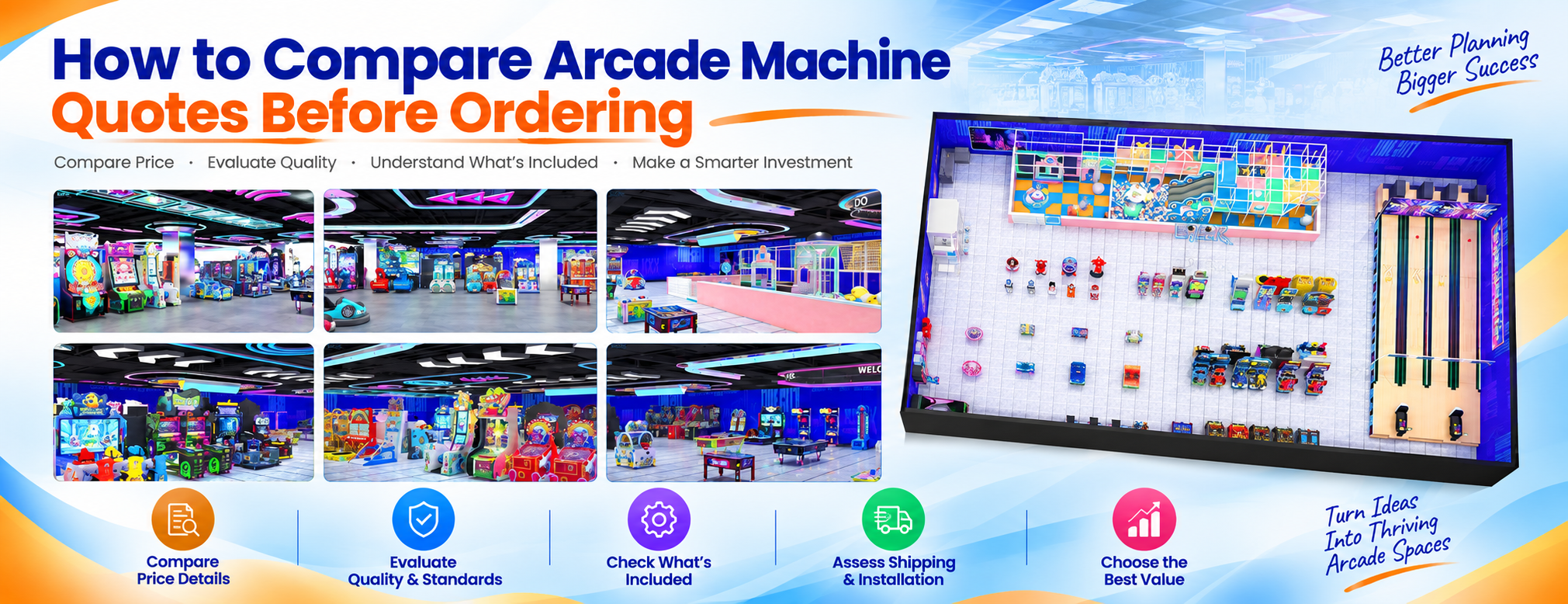
How to Compare Arcade Machine Quotes Before Ordering
Learn how to compare arcade machine quotes by checking specifications, customization, shipping, payment terms, warranty, and total project cost.
Buying commercial arcade machines often involves comparing quotations from several suppliers. At first glance, the process may seem simple: choose the lowest price and place the order.
In reality, two arcade machine quotations can look similar while representing very different products, configurations, services, and total project costs.
For FEC operators, arcade owners, distributors, importers, and entertainment investors, understanding how to compare quotations can help prevent unexpected expenses and make purchasing decisions more transparent.
A useful comparison should look beyond the unit price. Product specifications, customization, payment systems, packaging, shipping, warranty, spare parts, and delivery schedules can all affect the actual value of a quotation.
This guide explains how to compare arcade machine quotes before placing a commercial order.
1. Make Sure You Are Comparing the Same Product
The first step in comparing arcade machine quotations is confirming that the products are actually equivalent.
Two suppliers may use similar product names while offering different screen sizes, configurations, player capacities, hardware, payment systems, or included accessories.
Before comparing prices, create a clear reference for each machine. The reference should include the product category, model, dimensions, screen configuration, number of players, main functions, power requirements, and any important options.
This is particularly important for large arcade projects. A quotation for a standard configuration should not be compared directly with another quotation that includes additional features or customized components.
Buyers should also confirm whether the quoted price refers to one machine, a set, or a complete multi-player configuration.
When the product specifications are standardized first, the price comparison becomes much more meaningful.
2. Check What Is Included in the Quoted Price
An arcade machine quotation should be reviewed line by line rather than only looking at the final amount.
Some suppliers may include certain accessories or configurations as standard, while others may list them separately.
Check whether the quotation includes the machine cabinet, display, game system, controls, payment system, standard accessories, packaging, and other required components.
For larger projects, also confirm whether installation guidance, spare parts, or other services are included.
A lower quotation may initially appear more attractive because some items are excluded. Once these items are added later, the final cost may become much closer to or even higher than another supplier's quotation.
A clear quotation should make the scope of supply easy to understand.
If an item is not included, buyers should know this before placing the order rather than discovering it during production or installation.
3. Compare Technical Specifications, Not Product Photos
Product photos are useful for understanding appearance, but they are not enough for a professional purchasing comparison.
Buyers should compare technical specifications such as dimensions, screen size, player capacity, power requirements, game configuration, control system, and machine weight.
For large equipment, packed dimensions can also be important because they influence transportation and installation.
Different specifications can explain significant differences in price. A larger display, more complex hardware, additional player positions, or a mechanical system may increase production costs.
When comparing quotations, keep a written specification sheet and check each supplier against the same requirements.
This makes it easier to identify whether a price difference comes from a real product difference or simply from the supplier's pricing strategy.
4. Separate Standard Equipment From Customization
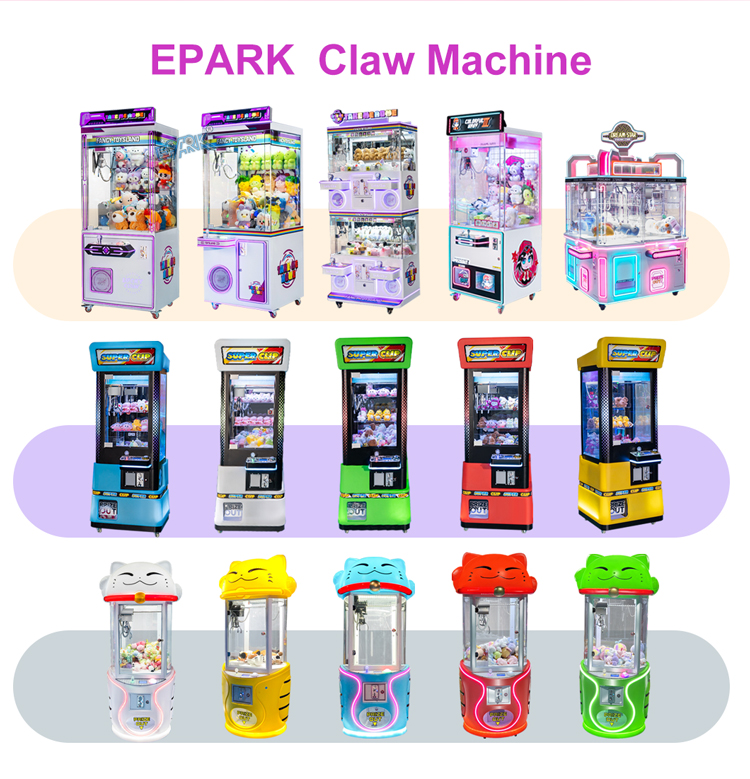
Customization is another area that can make quotations difficult to compare.
One supplier may quote a standard machine, while another may include customized artwork, branding, colors, language settings, payment systems, or other modifications.
Before comparing the prices, separate standard equipment from customized requirements.
If the project requires customized cabinets or branding, make sure every supplier is quoting the same customization scope.
Buyers should also ask whether customization affects production time.
Artwork development, engineering changes, payment-system modifications, and special configurations may require additional preparation before manufacturing can begin.
A clear comparison should therefore show the standard machine price and any customization costs separately whenever possible.
5. Compare Shipping and Packaging Costs Separately
For international buyers, the machine price is only one part of the purchasing cost.
Packaging and transportation can significantly affect the final investment, especially when machines are large or when the order contains many units.
Ask suppliers to clarify the packaging method, package dimensions, package quantity, and estimated shipping requirements.
The quotation should also make it clear whether shipping is included or quoted separately.
Buyers should understand the commercial shipping term being used and what costs are included at each stage of transportation.
For example, a factory quotation and a delivered quotation may represent very different cost structures.
Comparing the machine price without considering shipping can result in an inaccurate purchasing decision.
For large FEC projects, it is useful to estimate the complete equipment cost through delivery rather than focusing only on the factory unit price.
6. Look at the Total Project Cost
A professional price comparison should calculate the total cost rather than simply ranking suppliers by machine price.
The total project cost may include equipment, customization, packaging, shipping, installation, spare parts, and other project-related expenses.
Importers may also need to consider local transportation, customs-related costs, warehouse handling, and installation requirements depending on the destination market.
The exact costs vary by project, but the principle is simple: compare the complete purchasing picture.
A machine that costs slightly more at the factory may provide better overall value if it includes stronger equipment specifications, better support, or more complete project services.
This is why the cheapest quotation is not always the cheapest solution.
7. Compare Payment Terms and Production Conditions
Payment terms can also affect the purchasing decision.
Before ordering, buyers should understand the required deposit, balance payment arrangement, production conditions, and any relevant order requirements.
The quotation should clearly state the payment structure agreed between the buyer and supplier.
Production lead time should also be compared.
A supplier with a lower price but a significantly longer production schedule may not be the best choice for a project with a fixed opening date.
Buyers should ask when production starts, how customization affects the schedule, when testing is completed, and when the machines are expected to be ready for shipment.
A clear schedule helps the buyer coordinate equipment delivery with venue construction and installation.
8. Compare Warranty, Spare Parts, and Technical Support
After-sales support should be treated as part of the quotation comparison rather than as a separate issue.
Commercial arcade machines are designed for frequent use, so buyers should understand what happens if a machine requires technical assistance after delivery.
Compare the warranty terms, technical support process, spare-parts availability, and communication method.
For international buyers, remote troubleshooting can be particularly useful.
Ask whether the supplier can provide operation manuals, maintenance information, troubleshooting guidance, replacement parts, and technical communication after delivery.
Spare-parts arrangements should also be considered for large projects. Having commonly used components available can help operators reduce downtime.
A quotation that includes stronger long-term support may provide greater business value even when its initial price is not the lowest.
9. Ask for a Clear Quotation Format
A clear quotation makes supplier comparison much easier.
Ideally, the quotation should identify the product, quantity, unit price, total price, customization, packaging, shipping information, production lead time, payment terms, and other important conditions.
Buyers can create a comparison table using the same categories for every supplier.
This prevents important differences from being hidden inside a general total price.
It also makes communication easier when the buyer needs to ask why one quotation is higher or lower than another.
For distributors and repeat buyers, maintaining a consistent quotation format can make future purchasing decisions faster and more organized.
10. Do Not Choose a Supplier Based on Price Alone
Price is an important part of commercial purchasing, but it should not be the only decision factor.
A reliable buying decision considers product suitability, manufacturing capability, quality, service, delivery, and long-term operating value.
A very low quotation may be attractive initially, but buyers should understand why the price is lower.
It may represent a different machine configuration, fewer included components, a different payment system, less customization, or a different service scope.
On the other hand, the highest quotation is not automatically the best either.
The objective is to find the quotation that provides the most suitable combination of equipment, service, delivery, and total business value for the project.
How EPARK Helps Buyers Prepare Clear Arcade Equipment Quotations
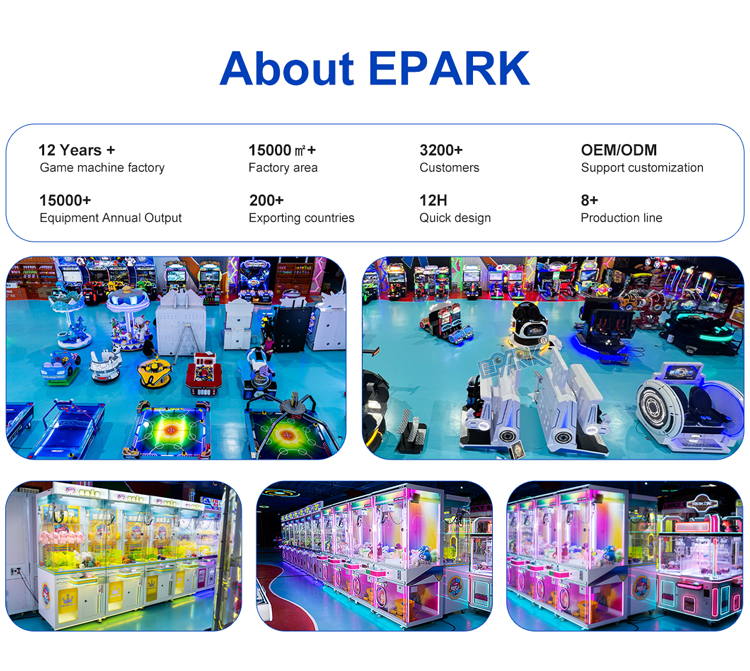
EPARK is a professional arcade machine manufacturer based in Guangzhou, China, with more than 14 years of industry experience.
EPARK supplies commercial entertainment equipment for FEC operators, arcade owners, distributors, importers, wholesalers, and entertainment investors.
The product range includes arcade game machines, racing games, shooting games, claw machines, redemption games, sports arcade equipment, VR equipment, kiddie rides, and complete FEC solutions.
For project customers, quotations can be prepared according to equipment requirements, quantities, customization needs, and project conditions.
EPARK can also support equipment selection, layout planning, production, quality inspection, packing, shipping, installation guidance, spare-parts support, and after-sales service.
Providing clear project information at the quotation stage helps both the buyer and manufacturer understand exactly what is being purchased.
FAQ
Why are arcade machine quotations from different suppliers sometimes very different?+
Price differences can come from product specifications, hardware configuration, customization, payment systems, quantity, packaging, shipping arrangements, and service scope. Buyers should compare the complete quotation rather than only the unit price.
What information should an arcade machine quotation include?+
A useful quotation should identify the machine, quantity, specifications, unit price, total price, customization, packaging, shipping information, production lead time, payment terms, and applicable service or warranty conditions.
How can I choose the best arcade machine quotation?+
Compare quotations using the same product specifications and project requirements. Then evaluate total cost, equipment quality, production capability, delivery schedule, warranty, spare parts, technical support, and long-term operating value.
Conclusion
Comparing arcade machine quotes is an important part of commercial equipment purchasing.
The best comparison is not simply a list of the lowest and highest prices. Buyers should first make sure that the products and configurations are comparable, then review what is included, customization, shipping, payment terms, production schedules, warranty, spare parts, and technical support.
Looking at the total project cost provides a much clearer picture of the actual investment.
For FEC operators, distributors, and entertainment investors, a detailed quotation comparison can reduce purchasing surprises and make it easier to choose equipment that supports long-term business goals.