How Many Arcade Machines Should You Order for Your Business?
Learn how to determine the right arcade machine order quantity based on venue size, business model, budget, customer demand, and future expansion.
Introduction
Deciding how many arcade machines to order is an important purchasing decision for any entertainment business. Buying too few machines may leave valuable floor space unused, while buying too many can tie up capital and create unnecessary inventory pressure.
For FEC operators, arcade owners, distributors, importers, and entertainment investors, the right order quantity depends on much more than venue size. Customer demand, business model, equipment categories, available budget, shipping arrangements, and future expansion all need to be considered together.
The first order also has a different purpose depending on who is buying. An FEC operator may be preparing equipment for one specific venue, while a distributor may be building inventory for several customers or testing products in a new market.
There is no universal number that works for every arcade project. A better approach is to determine an order quantity based on the actual business requirements and then create a purchasing strategy that can be adjusted as the business develops.
1. Start With the Purpose of Your Order
The first question should be why you are purchasing arcade machines. The purpose of the order will influence almost every other purchasing decision.
If you are opening a new arcade, the machines need to support the planned customer experience and make appropriate use of the available venue. If you are an established operator expanding an existing location, the order may focus on adding specific categories that are already showing customer demand.
Distributors have a different requirement because their machines are purchased for resale. They need to consider expected customer demand, warehouse capacity, local market preferences, and the likelihood of repeat orders.
Importers may also be testing a new product category for their market. In this situation, ordering a manageable quantity can provide useful information before a larger investment is made.
Understanding the purpose of the order prevents buyers from choosing a quantity simply because a supplier recommends it or because a particular number seems attractive.
The right quantity should support a clear commercial objective, whether that objective is opening a new venue, expanding an existing arcade, testing a market, or maintaining inventory.
2. Match Order Quantity to Your Venue Size
Venue size is one of the most obvious factors affecting arcade machine quantity, but available floor area should not be treated as a simple calculation of how many cabinets can physically fit.
Customers need space to walk, play, wait, interact with other visitors, and move between different entertainment zones. Staff also need access for cleaning, maintenance, and daily management.
Large attractions such as racing simulators, VR systems, multiplayer games, and motion equipment can require considerably more floor space than standard arcade cabinets.
This means two venues with the same total area may require very different equipment quantities depending on the machine categories selected.
A good purchasing plan should therefore consider usable entertainment space rather than simply the total square footage of the building.
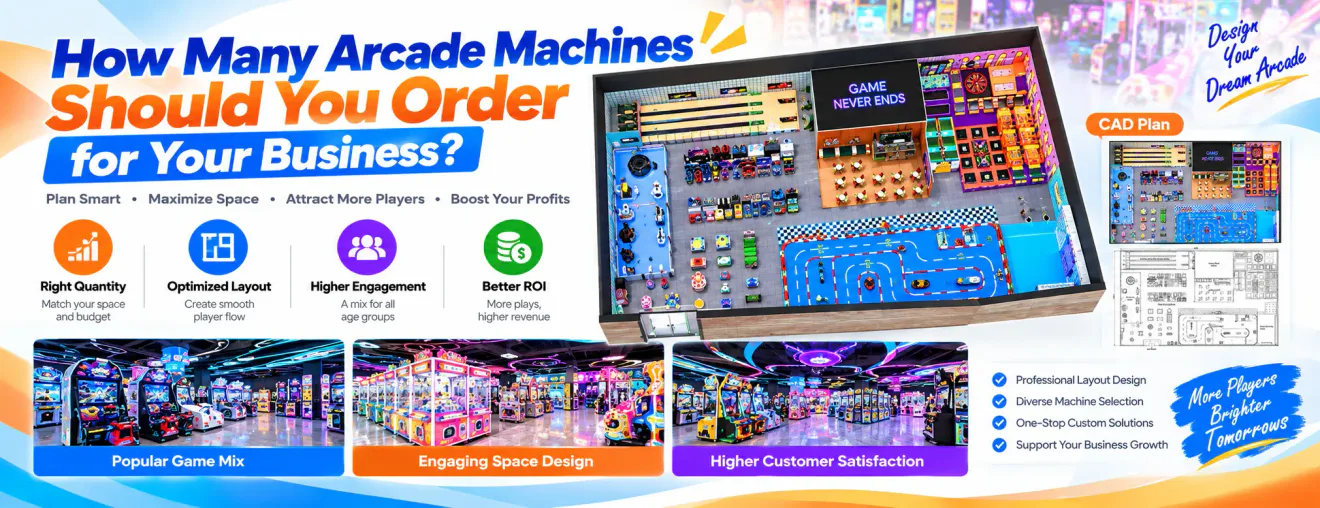
Before ordering, investors should understand the planned layout and identify how much space each equipment category will occupy. This makes it easier to estimate a practical number of machines without creating an overcrowded environment.
3. Consider Your Business Model
The ideal order quantity changes significantly depending on the business model. A single-location FEC, independent arcade, distributor, wholesaler, and multi-location operator may all purchase arcade equipment for completely different reasons.
A new FEC usually needs enough equipment to create a complete entertainment experience from the opening day. The focus is on creating a balanced venue rather than maximizing the number of machines.
An established arcade may already have reliable customer data. Its next order can be based on machines that have demonstrated strong demand or on categories that are currently missing from the venue.
Distributors need to think about inventory turnover. Ordering a large quantity may improve purchasing efficiency, but it can also increase storage requirements and tie up capital if products move slowly.
For importers entering a new market, the first order may be used to test customer response before increasing inventory.
Understanding the business model helps buyers determine whether the first order should be designed around immediate operation, inventory availability, market testing, or long-term expansion.
4. Do Not Put the Entire Budget Into the First Order
Budget management is an important part of determining order quantity. The available investment should not automatically be spent entirely on arcade machines.
An entertainment project may also require venue preparation, electrical work, decoration, shipping, installation, marketing, staff preparation, and working capital.
If the entire equipment budget is committed to the first order, the business may have less flexibility after the machines arrive.
Keeping part of the available capital for future needs can be particularly useful for new entertainment venues. Customer demand may differ from the original forecast, and some equipment categories may perform better than expected.
For distributors, reserving capital can also make it easier to reorder products that receive strong customer demand.
The objective is therefore to find a quantity that is financially comfortable rather than simply the largest quantity the buyer can afford.
5. Think About Product Mix Instead of Machine Count Alone
The number of machines is important, but the product mix may be even more important.
A venue with twenty machines from one category may offer less variety than a venue with a smaller number of carefully selected machines from several categories.
Customers may want racing, sports, prize, redemption, interactive, VR, and family entertainment experiences during the same visit.
A balanced product mix gives different customer groups more opportunities to find suitable attractions.
It can also help operators understand which categories perform best after opening.
For a distributor, product variety can be useful because different customers may have different requirements. A broader but carefully controlled inventory can provide more sales opportunities without requiring excessive quantities of every individual model.
The right first order should therefore consider both quantity and variety rather than treating the number of machines as the only purchasing target.
6. Consider a Test Order Before Scaling Up
A test order can be useful when a buyer is entering a new market or purchasing from a new product category.
The purpose of a test order is not simply to minimize spending. It is to collect information about customer response, machine performance, operating requirements, and local demand.
After the equipment has been operating for a reasonable period, the buyer can evaluate which machines attract customers and which products may require a different strategy.
This information can support a larger second order based on actual market experience.
However, a test order should still be large enough to provide meaningful information. Testing only one isolated product may not reveal how different machine categories perform together inside an entertainment venue.
For distributors, a controlled first order can also help evaluate how quickly products move through the local sales channel before additional inventory is purchased.
A gradual purchasing strategy can therefore reduce uncertainty while giving the buyer a clearer understanding of the market.
7. Consider Shipping and Storage Capacity
Order quantity also affects logistics. More machines generally require more transportation space, larger warehouse capacity, and more preparation for receiving the shipment.
For international buyers, machine dimensions and packed volume should be considered before the final quantity is confirmed.
A buyer may have enough budget to purchase a large number of machines but discover that the shipment requires more storage or transportation capacity than expected.
Distributors should pay particular attention to warehouse capacity because unsold equipment may need to remain in storage until the next customer order arrives.
FEC operators should also consider the timing of delivery. Equipment should ideally arrive when the venue is ready for installation rather than creating a long storage period before opening.
Understanding logistics before ordering helps buyers choose a quantity that is practical not only financially but also physically.
8. Plan for Reorders and Future Expansion
The first order should not be viewed as the final equipment investment.
A successful arcade business may add new machines, replace underperforming equipment, expand the venue, or open additional locations in the future.
For this reason, buyers should consider how the first order will connect with future purchasing.
If a distributor discovers strong demand for a particular machine, a reliable supply relationship can make repeat orders easier to manage.
An FEC operator can also use the first several months of operating data to determine which categories deserve more investment.
Future orders can therefore be more targeted than the original purchase because they are based on actual customer behavior.
Planning for reorders also reduces the pressure to purchase excessive quantities at the beginning simply because the buyer wants to avoid ordering again later.
A flexible purchasing strategy allows the equipment investment to develop together with the business.
9. Confirm the Order Quantity With the Manufacturer
Once the business requirements are clear, buyers should discuss the proposed quantity with the arcade equipment manufacturer.
An experienced manufacturer can review the equipment mix, machine dimensions, production requirements, and project schedule and identify potential issues before the order is finalized.
For large orders, the manufacturer can also help coordinate different machine categories so that the final shipment matches the project's requirements.
Communication is particularly important when the order contains customized equipment or multiple configurations.
The buyer should confirm the final models, quantities, specifications, customization, delivery destination, and expected production schedule before production begins.
This written confirmation creates a clear reference for both sides and reduces misunderstandings during manufacturing.
The supplier's experience can be useful, but the final quantity should still be based on the buyer's own venue, market, budget, and business objectives.
How EPARK Supports Arcade Equipment Purchasing
EPARK is a professional arcade machine manufacturer based in Guangzhou, China, with more than 14 years of industry experience.
EPARK supplies commercial entertainment equipment for FEC operators, arcade owners, distributors, importers, wholesalers, and entertainment investors in global markets.
The product range includes arcade game machines, racing machines, shooting games, claw machines, redemption games, sports arcade equipment, VR equipment, kiddie rides, and complete FEC solutions.
For project customers, EPARK can help review venue requirements, target customers, equipment categories, quantities, customization needs, and delivery schedules before production.
This allows buyers to develop a purchasing plan based on their actual business requirements rather than choosing an arbitrary machine quantity.
FAQ
How many arcade machines should I order for a new arcade?+
There is no universal number because the right quantity depends on venue size, usable floor area, target customers, equipment categories, investment budget, and business model. A balanced equipment mix is generally more useful than simply maximizing the number of machines.
Should distributors place a large first order?+
Distributors should consider expected local demand, warehouse capacity, available capital, and product turnover before deciding on a large order. A controlled first order can be useful when testing unfamiliar products or a new market.
Is it better to buy more machines to get a better price?+
A larger order may provide commercial advantages in some purchasing situations, but buyers should consider whether the additional inventory is actually needed. A lower unit cost does not automatically create better value if the equipment remains unused or takes too long to sell.
Conclusion
Choosing the right arcade machine order quantity requires a balance between customer demand, venue capacity, business model, budget, logistics, and future growth.
New FEC operators should focus on creating a balanced entertainment experience, while distributors and importers may need to consider inventory turnover and market testing.
The first order does not need to determine the entire future of the business. A flexible purchasing strategy allows operators and distributors to learn from real customer demand and make better decisions on future orders.
By planning the quantity carefully and discussing the project requirements with an experienced arcade equipment manufacturer, buyers can avoid unnecessary inventory pressure while building a stronger foundation for long-term entertainment business growth.