How to Plan an FEC Budget Before Buying Arcade Machines
Learn how to plan an FEC budget before buying arcade machines, including equipment, venue costs, shipping, installation, working capital, and contingency funds.
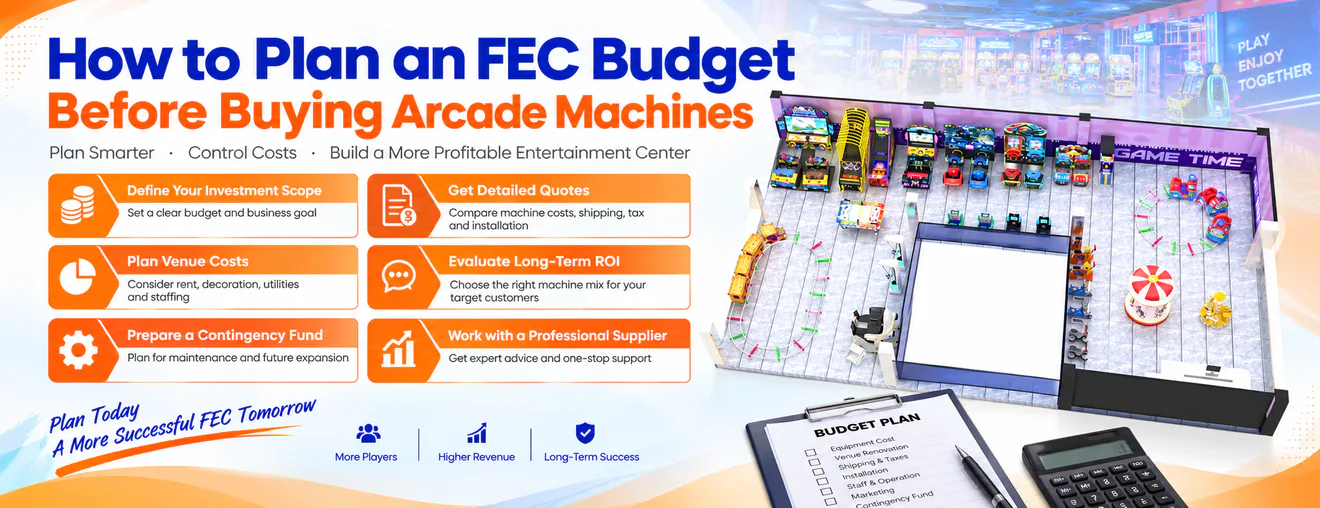
Planning an FEC investment starts with a realistic budget. For arcade investors, FEC operators, shopping mall entertainment developers, and business owners, the cost of arcade machines is only one part of the total investment.
Venue preparation, decoration, electrical work, shipping, installation, staffing, marketing, working capital, and future equipment updates can all influence the amount of capital required before the business reaches stable operation.
A common mistake is to calculate the project budget simply by multiplying the number of machines by their unit prices. A more practical approach is to consider the complete project from the initial venue preparation through opening and early operation.
1. Start With the Total FEC Investment
Before deciding how many arcade machines to purchase, investors should establish an overall investment range for the project. A small arcade inside an existing commercial space can have a very different cost structure from a large standalone family entertainment center.
The total investment may include the venue, renovation, electrical infrastructure, lighting, air conditioning, signage, arcade equipment, shipping, installation, staff preparation, marketing, and early operating expenses.
The exact proportion of each cost depends on the country, location, venue condition, business model, and project size. This is why there is no single equipment budget that works for every FEC.
Starting with the total investment prevents a common problem: spending too much of the available capital on equipment and discovering later that there is not enough money for renovation, installation, marketing, or early operating expenses.
Investors should also determine whether the project will be developed in one stage or several stages. A phased approach may allow the business to open with a carefully selected equipment mix and expand later based on actual customer demand.
The initial budget should therefore be viewed as a business plan rather than simply a purchasing limit. It needs to support the venue from preparation through opening and provide enough flexibility for the first months of operation.
A clear total investment target also makes communication with equipment suppliers easier. When the supplier understands the project scale and budget range, equipment recommendations can be more closely matched to the actual business requirements.
2. Separate Venue Costs From Equipment Costs
Arcade machines are usually one of the most visible expenses in an FEC project, but venue preparation can have a major influence on the final investment.
An existing entertainment space with suitable flooring, electrical capacity, lighting, air conditioning, and customer areas may require limited preparation. An empty commercial unit may require considerably more work before machines can be installed.
Investors should evaluate the venue before finalizing the equipment budget. Electrical distribution, power capacity, ceiling height, ventilation, flooring, entrances, emergency routes, storage, and service areas can all affect project costs.
Decoration is another area that should be considered carefully. A themed FEC may require wall graphics, ceiling features, special lighting, signage, flooring, and branded customer areas.
The venue layout should also provide enough space around machines for customer movement and maintenance. Saving money by overcrowding equipment can create operational problems later and may reduce the quality of the customer experience.
Investors should therefore estimate venue preparation and arcade equipment as connected parts of the same project. The amount spent on machines should reflect what the venue actually requires to become operational.
Understanding the condition of the venue early also reduces the risk of unexpected construction expenses after equipment has already been ordered.
3. Build the Equipment Budget Around the Business Model
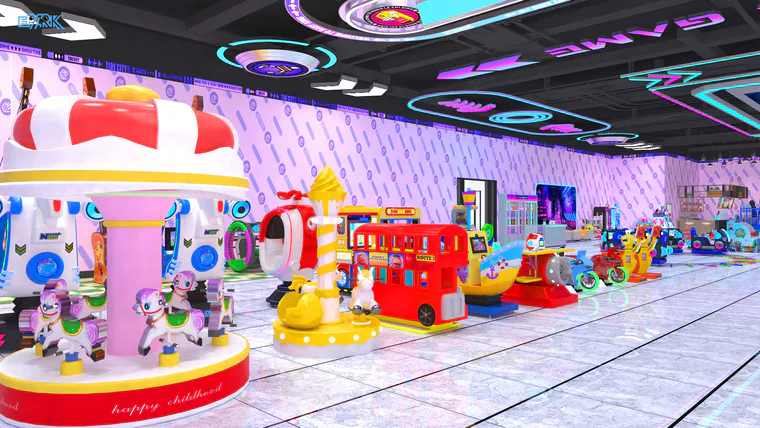
The equipment budget should be connected to the type of entertainment business being developed. A family entertainment center may require a combination of arcade games, redemption machines, claw machines, kiddie rides, sports games, and interactive attractions.
A youth-focused arcade may place more emphasis on racing games, shooting games, competitive games, VR experiences, and multiplayer attractions. A shopping mall project may require a broader mix because it needs to attract different customer groups.
Investors should consider target customers, expected traffic, local competition, available floor space, and the intended price per play when deciding how much equipment to purchase.
It is also important to avoid selecting machines simply because they look impressive. Every machine should have a role within the overall customer experience and business model.
Some attractions are designed to create visual impact and attract customers into the venue. Others encourage repeat play, provide prize-based entertainment, or create group experiences.
A balanced equipment budget can create a more diverse venue while reducing the risk of putting too much capital into one category. It also gives operators more opportunities to understand which types of games perform best.
For a new FEC, an experienced arcade equipment manufacturer can help investors compare categories and determine a practical equipment combination based on the venue and customer profile.
4. Include Shipping, Installation, and Infrastructure
International buyers should include logistics costs in the FEC budget before placing an equipment order. The factory price of an arcade machine does not necessarily represent the final cost of getting the equipment into the venue.
Packaging, international transportation, customs-related expenses, local delivery, unloading, and installation may all contribute to the total investment.
Large machines can require more transportation space and more complicated installation arrangements. Racing simulators, VR systems, motion attractions, and other specialized equipment may also require additional preparation at the venue.
The venue may need supporting infrastructure such as electrical distribution, network connections, centralized payment systems, CCTV, sound systems, lighting, air conditioning, and customer service equipment.
These expenses can be easy to overlook when the initial focus is on arcade machines. Investors should therefore ask suppliers for information about machine dimensions, power requirements, packed size, weight, and installation requirements.
For large FEC projects, equipment delivery should be coordinated with construction. Machines arriving too early can create storage problems, while late delivery can delay installation and opening.
A complete budget should therefore connect the equipment quotation with logistics and infrastructure requirements instead of treating the machine price as the final investment figure.
5. Reserve Money for Opening and Marketing
An FEC needs customers after the equipment has been installed, so opening and marketing expenses should be included in the initial financial plan.
Depending on the market, investors may need to budget for exterior signage, promotional materials, social media advertising, opening events, membership programs, local partnerships, and other customer acquisition activities.
The appropriate marketing investment depends on the location and business model. A venue inside a busy shopping mall may receive natural traffic, while an independent arcade may need stronger local marketing to establish awareness.
The opening period is especially important because the first customer experience can influence reviews, word-of-mouth recommendations, and repeat visits.
Investors should therefore make sure the venue is not only physically ready but also prepared with clear pricing, customer communication, staff training, promotional materials, and operating procedures.
Working with local partners can also help a new entertainment venue attract its first customer groups. Schools, shopping centers, family communities, and local organizations may provide useful opportunities depending on the market.
Marketing does not need to consume a large percentage of the project investment, but completely ignoring it can create difficulties after opening.
A realistic FEC budget should therefore reserve enough money to introduce the venue to the market and maintain customer acquisition during the early operating period.
6. Prepare Working Capital for the First Months
Working capital is one of the most important parts of FEC budget planning because revenue may not immediately reach the level expected in the original business plan.
A new venue needs time to build awareness, understand customer behavior, adjust pricing, optimize machine placement, and develop repeat traffic.
During this period, the business still needs to pay rent, salaries, utilities, maintenance, prize inventory, cleaning, marketing, and other operating expenses.
Investors should therefore avoid assuming that the venue will immediately generate enough revenue to cover every monthly expense.
The amount of working capital required depends on the local market, venue size, rent structure, staffing model, and expected customer traffic.
Keeping sufficient operating funds provides more flexibility when actual performance differs from the original forecast.
Working capital also allows operators to make reasonable adjustments after opening rather than making rushed decisions simply because the initial budget has been exhausted.
For investors, this is an important distinction between having enough money to open an FEC and having enough financial flexibility to operate it successfully after opening.
7. Create a Contingency and Future Upgrade Budget
Unexpected expenses are common in commercial entertainment projects. Construction changes, shipping delays, additional electrical work, equipment modifications, replacement components, and installation problems can all increase the original project cost.
A contingency fund provides financial flexibility when these situations occur. The appropriate amount depends on the complexity of the project and the condition of the venue.
A new venue with major renovation work may face more uncertainty than an existing entertainment space that already has suitable infrastructure.
The important principle is to reserve contingency funds before spending the entire investment budget. A project that uses every available dollar on planned expenses has very little flexibility when something unexpected happens.
Future equipment upgrades should also be considered as part of the long-term investment strategy. Customer preferences can change after the venue opens, and new arcade games or entertainment technologies may become available.
Instead of spending the entire equipment budget before opening, investors can reserve part of their future capital for equipment updates and new attractions.
After several months of operation, the operator can analyze which machines perform strongly and which categories receive less customer attention. Future investment can then be based on actual customer behavior rather than assumptions made before opening.
8. Plan the Budget in Different Project Stages
An FEC budget becomes easier to manage when the investment is divided into different project stages instead of being treated as one large expense.
The first stage may include market research, venue evaluation, project planning, design, and initial supplier discussions.
The second stage can cover equipment selection, quotations, customization, order confirmation, and production.
The third stage may include venue preparation, shipping, equipment delivery, installation, testing, staff preparation, and final opening work.
The final stage focuses on marketing, working capital, early operation, and future adjustments.
This staged approach makes it easier to track spending and compare actual costs with the original plan.
It also helps investors understand which expenses need to be paid early and which costs can be managed later as the project develops.
For international projects, staged budgeting can be particularly useful because equipment production, transportation, construction, and local installation may be handled by different parties.
Investors can use the same structure when comparing supplier quotations. Equipment cost, logistics, installation, and other project expenses can be reviewed separately before being combined into the total investment.
9. Work With a Supplier That Understands Project Budgeting
An experienced arcade equipment supplier can contribute more than a machine quotation. The supplier can help investors understand how equipment quantity, machine categories, venue size, and project requirements are connected.
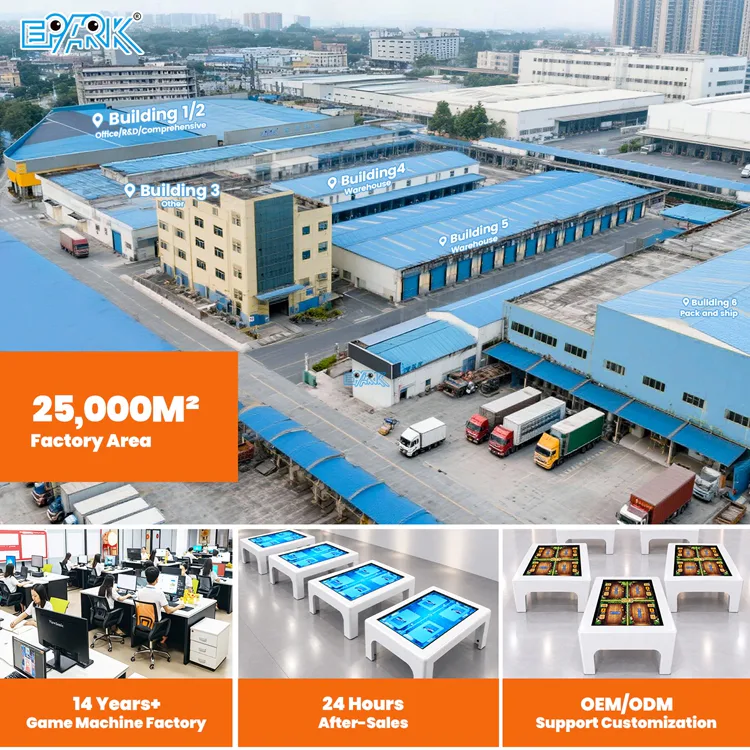
EPARK is a professional arcade machine manufacturer based in Guangzhou, China, with more than 14 years of industry experience.
EPARK provides commercial entertainment equipment for FEC operators, arcade owners, distributors, importers, wholesalers, and entertainment investors.
The product range includes arcade game machines, racing machines, shooting games, claw machines, redemption games, sports arcade equipment, VR equipment, kiddie rides, and complete FEC solutions.
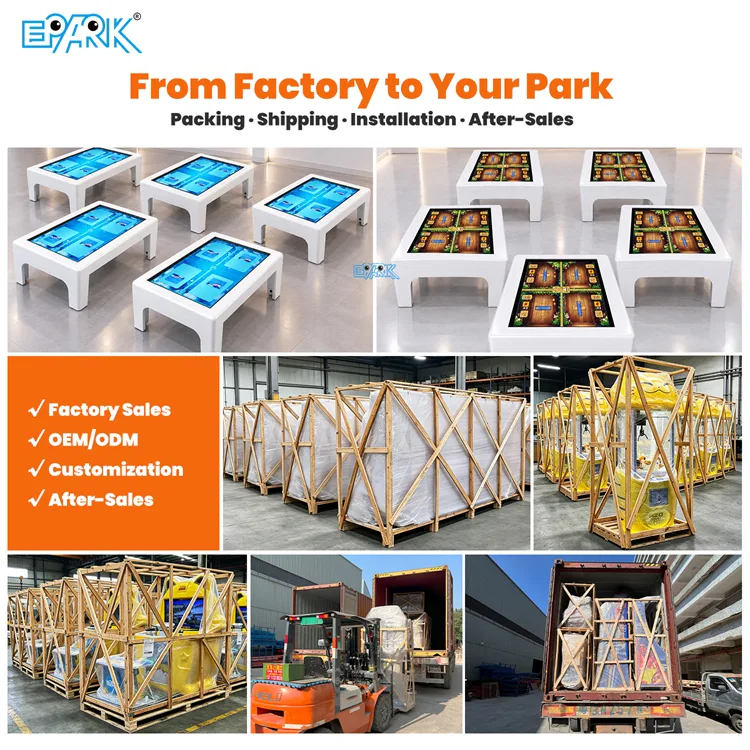
For project customers, EPARK can support equipment selection, quantity planning, layout suggestions, customization, production, quality inspection, packing, shipping, installation guidance, spare-parts support, and after-sales assistance.
By discussing the venue, target customers, available space, and investment requirements before equipment selection, buyers can develop a more practical equipment plan instead of simply purchasing machines based on unit price.
A supplier that understands the entire project can also help buyers identify equipment requirements that may otherwise be overlooked during the early planning stage.
FAQ
How much should I budget for arcade machines in an FEC?+
There is no universal equipment budget because costs depend on venue size, target customers, machine categories, quantity, customization, and local market conditions. Investors should determine the total project budget first and then allocate an appropriate amount to arcade equipment while keeping funds available for venue preparation and operation.
What costs are often forgotten when opening an FEC?+
Commonly overlooked expenses include shipping, installation, electrical infrastructure, air conditioning, payment systems, signage, marketing, staff preparation, spare parts, maintenance, and working capital for the first months of operation.
Should I spend my entire budget on arcade machines?+
Usually, it is better to keep part of the investment available for venue preparation, early operating expenses, unexpected costs, and future equipment updates. A balanced budget provides more flexibility and reduces financial pressure after opening.
Conclusion
FEC budget planning should begin before the first arcade machine is ordered.
A complete financial plan should consider equipment, venue preparation, shipping, installation, infrastructure, marketing, working capital, contingency funds, and future equipment updates.
The objective is not simply to purchase as many machines as possible. It is to allocate capital in a way that creates a strong entertainment experience while leaving enough financial flexibility for daily operation and future development.
For FEC investors and arcade operators, a well-planned budget can reduce financial pressure, improve purchasing decisions, and provide a stronger foundation for long-term business growth.